Bond Project Information

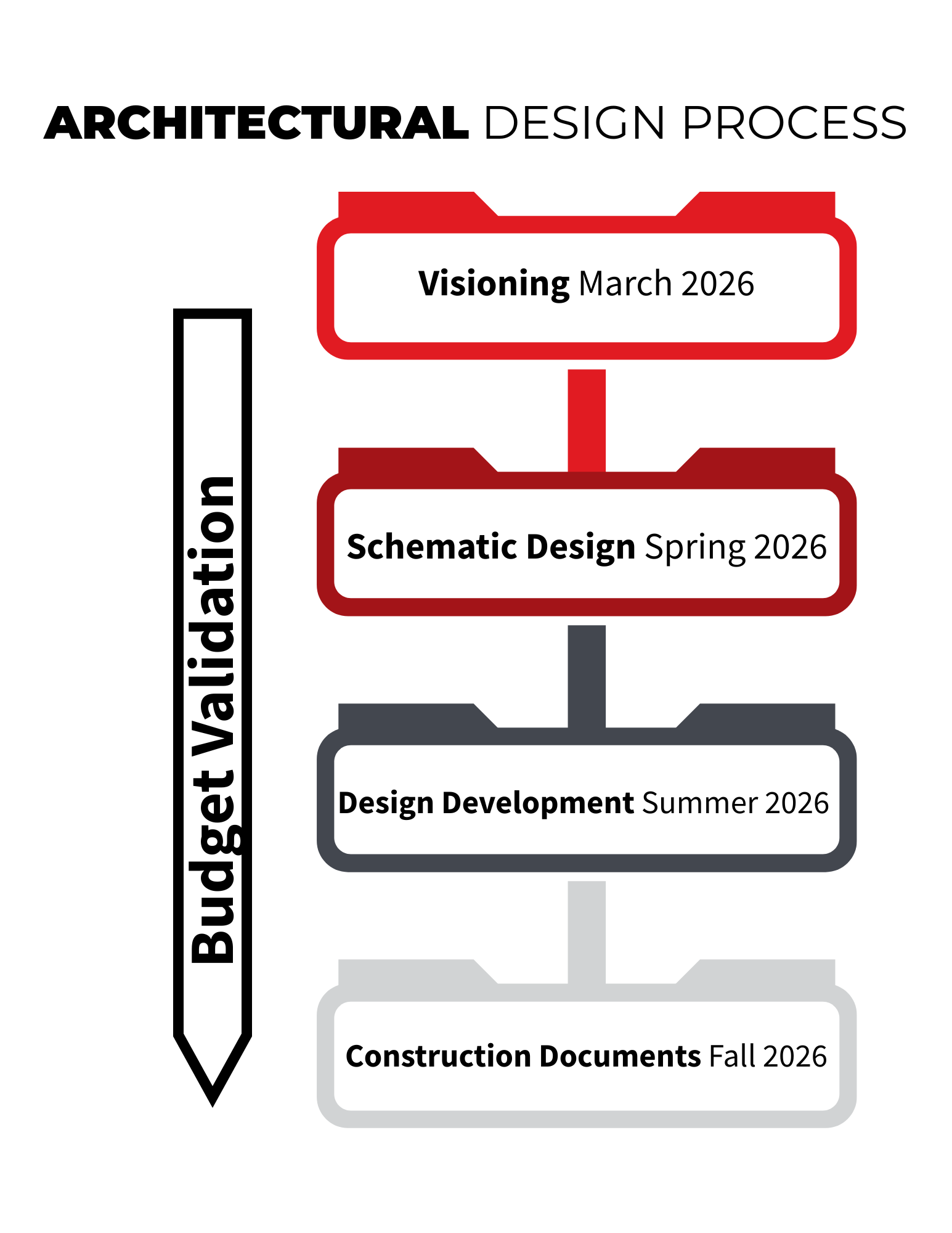
From this input, iDS will develop a detailed space program that defines what spaces are required, how large they need to be, and how they should relate to one another. This ensures the design reflects both instructional goals and day-to-day realities before floor plans are advanced. As program clarity is established, the process transitions into Schematic Design.
Public Information Session Overview
Public Information Session Documents
Taxpayer Cost Calculator
Two Questions, One Plan
Two Questions, One Plan
Question 1 - No Mill Increase - $62.5M
Uses the mill rate already being paid for an existing bond. Passing this question will not increase the current tax rate.
1. Renovate and renew the High School
- New academic wing
- Career and technology labs
- Safety and Security Updates
- Technology Upgrades
- HVAC work
- Electrical improvements
- Roof improvements
- Additional auxiliary gym
- Demolish hexagons
2. Safe and secure entrances at Lincoln and Roosevelt
3. Pay off the existing leases for HVAC/energy improvements and turf field and track facility
McPherson High School might look like this...
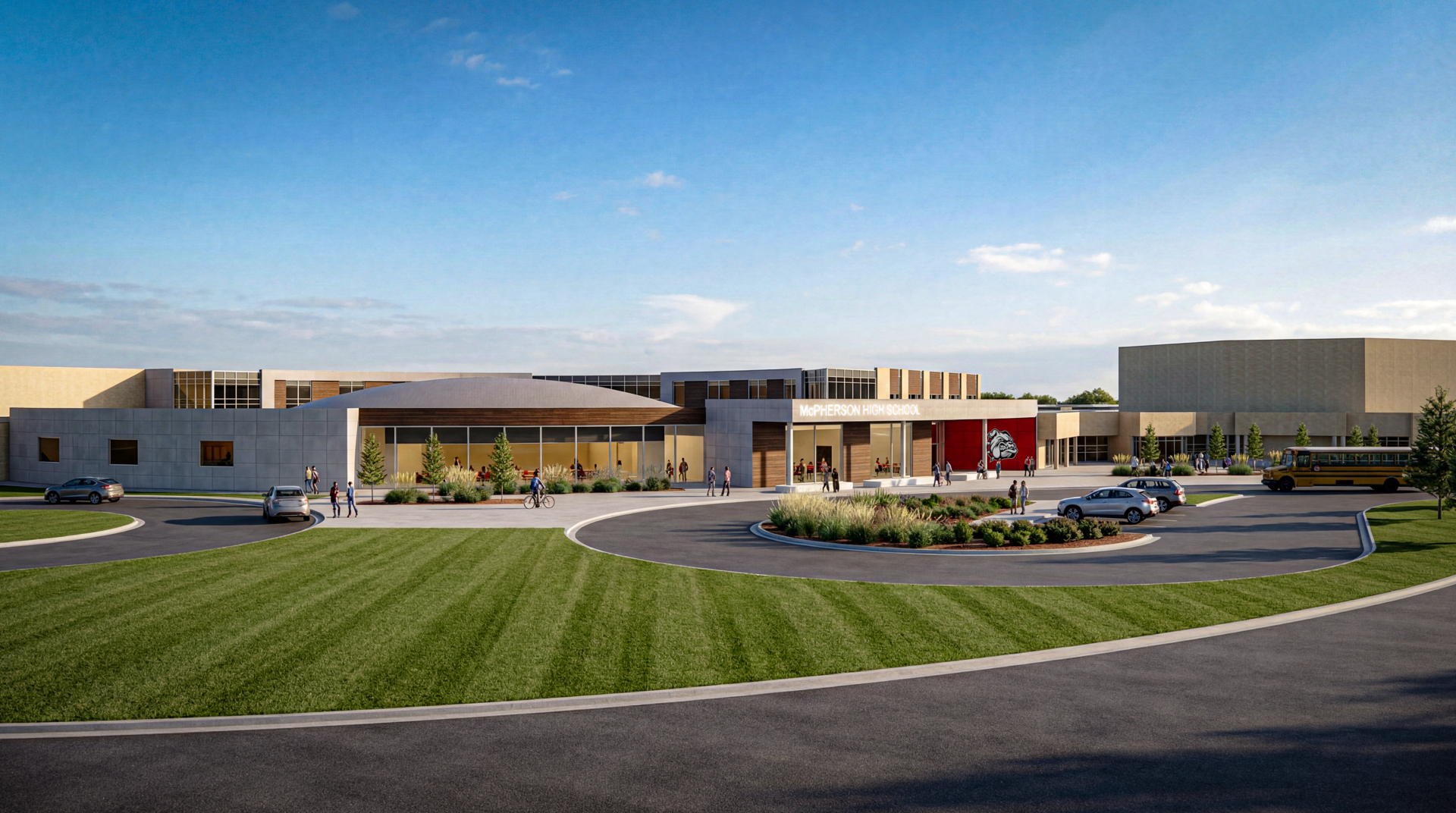
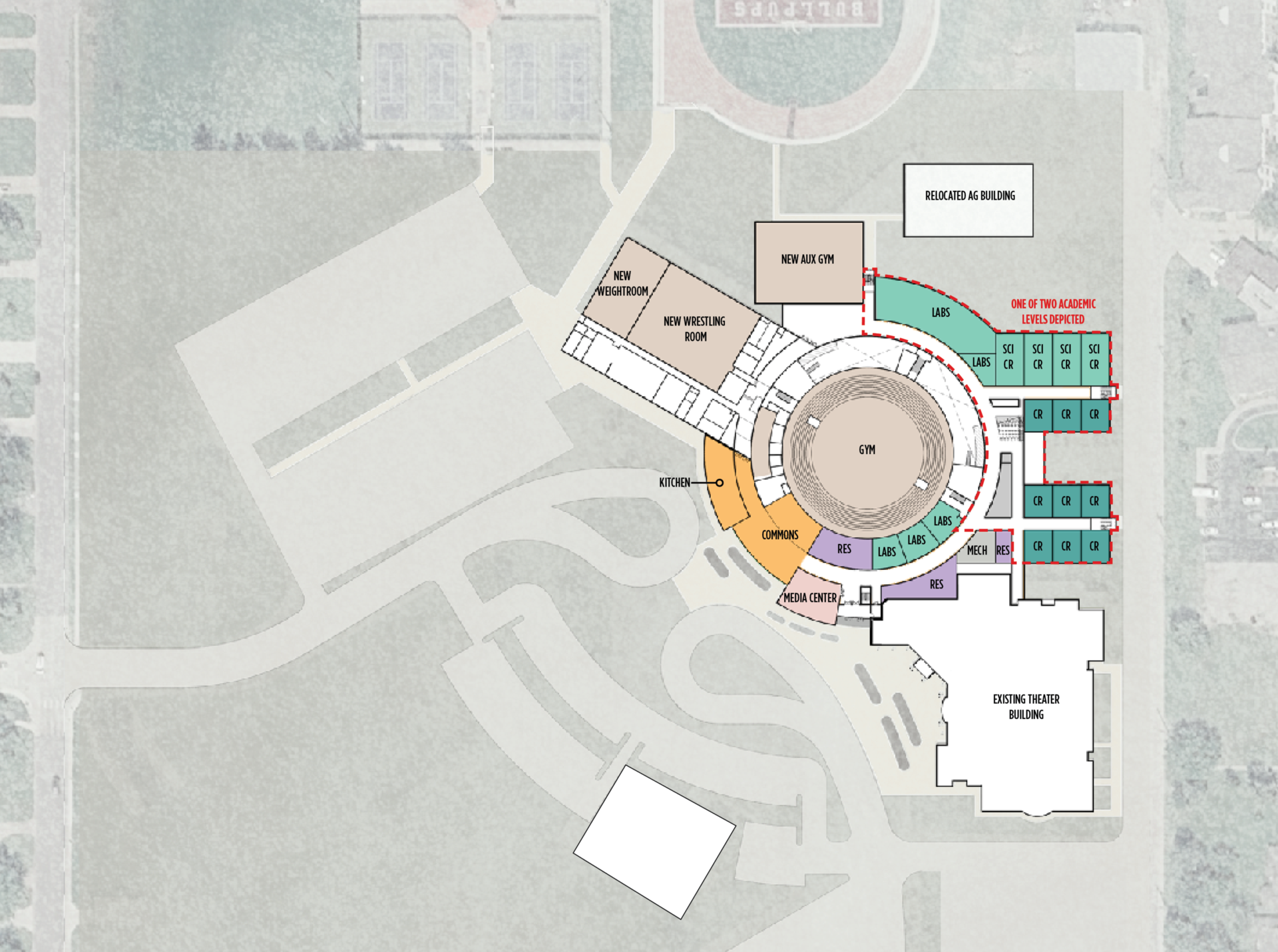
Rendering concept: These images show a general idea of what the building could look like. Final design work will occur after a successful bond election, and details may change based on stakeholder feedback and needs.
Question 2 - 4.75 Mill Increase - $27M
Project 1 MUST pass for Project 2 to move forward.
The estimated tax impact for project 2 is 4.75 mills, or about $9.10 per month for the average homeowner ($200K house).
1. Addition and Renovations at existing Eisenhower Elementary to become Middle School
- Secure entrance
- Competition gymnasium
- Performing Arts space
- Science and Technology rooms
McPherson Middle School might look like this
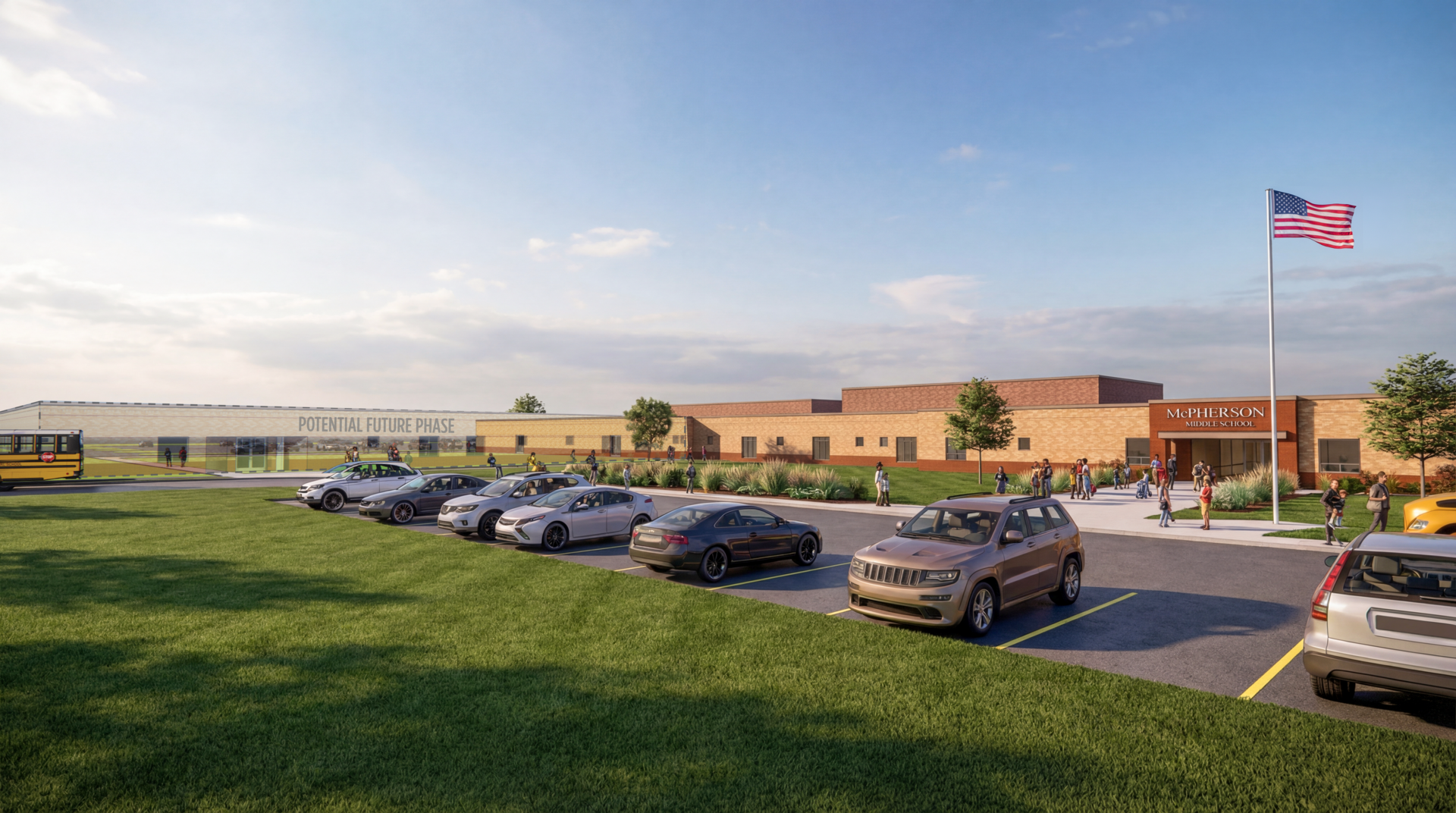
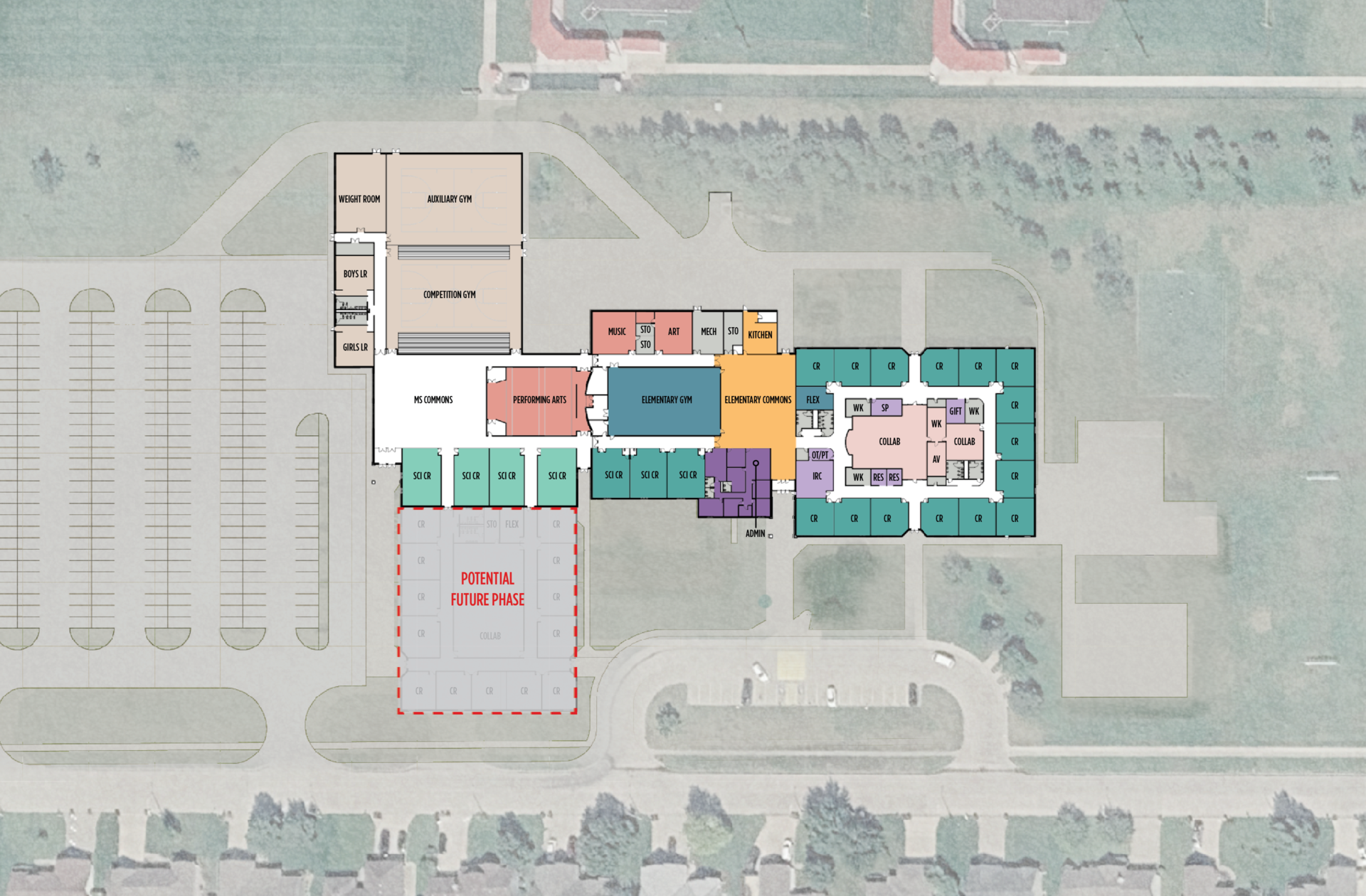
Rendering concept: This image shows a general idea of what the building could look like. Final design work will occur after a successful bond election, and details may change based on stakeholder feedback and needs.
Why do the facilities challenges in McPherson Public Schools exist?
This challenge is not unique to McPherson. Across Kansas and beyond, the funding available to school districts does not keep up with the cost of maintaining and replacing aging buildings and systems.
In this video, Dave explains why regular school budgets are not designed to handle major facility replacements and why bond funding is a necessary part of school facility work.
Watch to learn how this funding gap developed and how planning ahead helps protect taxpayer dollars, strengthen schools, and support inspired students.
When major systems in school buildings fail, the cost to fix them is often 30 to 50 percent higher than planned work done ahead of time. Here’s why:
- Repairs must happen right away to keep schools open
- Emergency work limits contractor choices
- Urgent jobs often cost more
- Repairs usually fix only one problem, not the whole system
- Materials must be ordered quickly instead of planned ahead
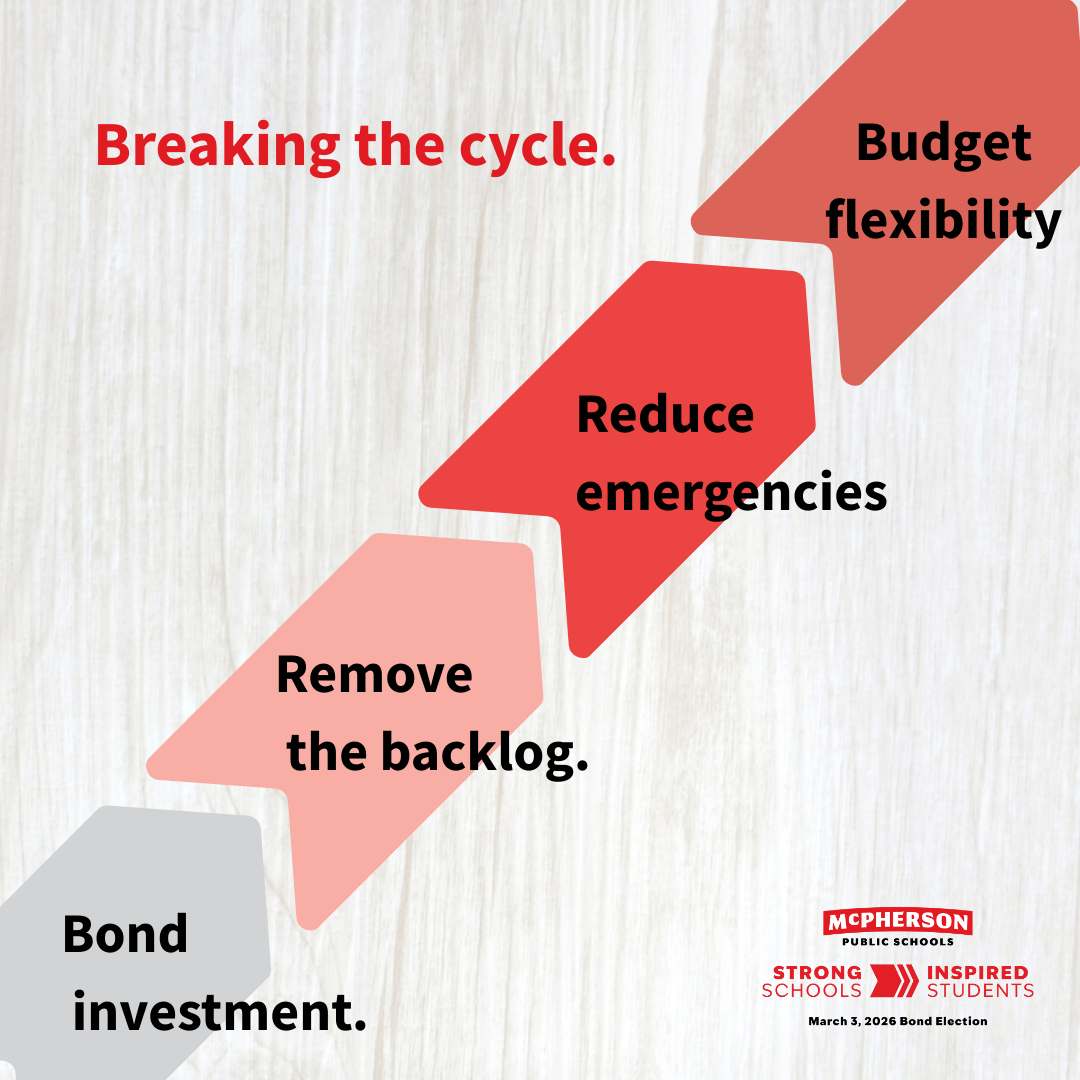
Bond projects allow the district to replace aging systems before they break, not after. This helps avoid emergencies, lowers costs, and reduces disruptions for students.
Planning ahead helps protect taxpayer dollars and supports strong schools and inspired students.
Above, we’ve highlighted how short-term, emergency fixes are more expensive than preventative maintenance and yet the funding available for maintenance consistently falls short of the needs a district has. Because of those realities, McPherson Public Schools and districts across the state face a common challenge.
Here is how the cycle works:
Buildings age. Major systems reach the end of their life.
Needs grow faster than the budget. Annual budgets are designed to operate schools, not replace large systems all at once.
Short-term fixes are required. Repairs are made to keep buildings open and safe.
Emergencies cost more. Work must happen immediately, often at higher cost.
Less money is left for long-term solutions. Funds are used to respond, not to prevent.
Backlogs increase. More systems age, and the cycle repeats.
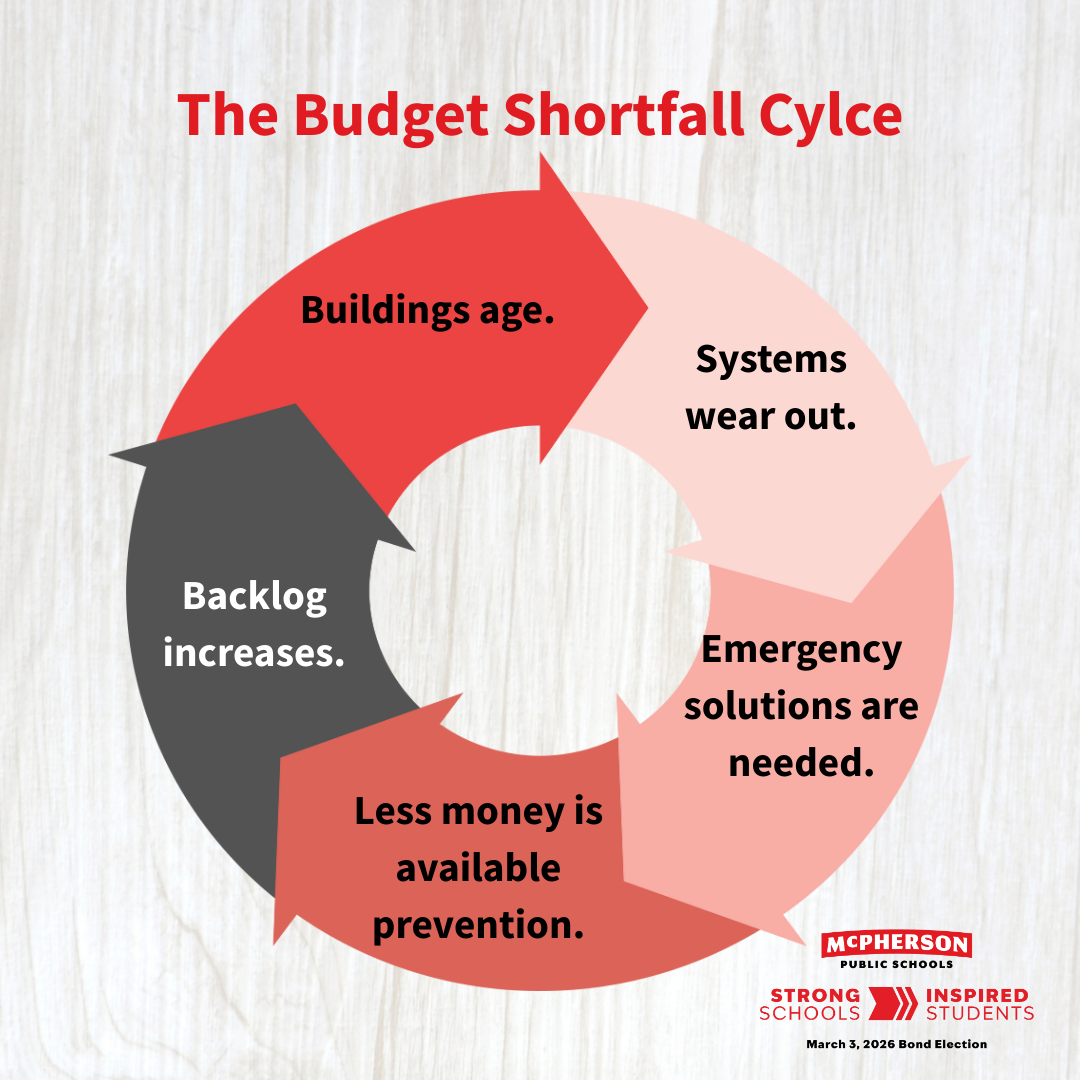
The only way to break this cycle is with a larger, one-time investment through a bond. A bond allows the district to address major needs at once, reduce emergency repairs, and build a strong foundation for the future.
Plan Element History and Cost Breakdown
| Plan Element | Where It Originated | Priorities |
| Fix HS/Eisenhower flooding & drainage | Staff/admin, community comments, committee analysis | Maintenance & Infrastructure, Equity Across Schools |
| Districtwide HVAC/roof/MEP upgrades | Staff surveys, community raw data | Maintenance & Infrastructure, Equity Across Schools |
| Secure entries | Principals, staff, community, polls | Safety & Security, Equity Across Schools |
| Storm shelters | Admin interviews, community poll, community raw data. | Safety & Security, Equity Across Schools |
| Consolidate to three PreK–5 elementary schools | Admin interviews, staffing/efficiency data, community input |
Elementary Consolidation, Operational Efficiency, Equity Across Schools
|
| Eisenhower becomes the 6–8 Middle School | Committee meeting No.1, poll results |
New Secondary Schools, Modern Learning Spaces, Operational Efficiency
|
| Renovate & expand the High School on its current site | Community poll, committee guidance |
New Secondary Schools, Modern Learning Spaces, Operational Efficiency
|
| Preserve stadium, PAC & Roundhouse | Community preference, fiscal stewardship | New Secondary Schools |
| Reduce operating costs & improve efficiency | Admin interviews, community feedback, committee fiscal themes | Operational Efficiency |
| Question 1 | ||
| Renovate and Renew the High School | ||
| Remaining 108,000SF + Addition | $52,000,000 | |
| High School Building Updates | $4,000,000 | |
| Demolish hexagons | $870,000 | |
| Elementary Secure Entrances | ||
| Lincoln and Roosevelt | $1,000,000 | |
| Lease Purchase Payoffs | ||
|
2017 Lease – Central Plant & Eisenhower Upgrades |
$4,630,000 | |
| $62,500,000 | ||
| Question 2 | ||
|
Reimagine Eisenhower site as McPherson Middle School
|
||
| Existing building 52,000SF + Addition | $18,000,000 | |
| New Middle School building updates | $3,700,000 | |
|
Elementary Building Updates
|
||
| Modern academic spaces | $3,500,000 | |
|
High School Improvements - Outdoor facility
|
||
| Restroom, concessions, seating | $1,800,000 | |
| $27,000,000 | ||
Ballot Language
The official ballot language is below:
Project No. 1. It is hereby deemed necessary and advisable to: (a) construct, furnish, and equip improvements, renovations and additions to the existing High School facility including new academic wing, auxiliary gym, career and technology labs, safety and security improvements, technology upgrades, HVAC, and electrical and roof improvements; (b) construct, furnish and equip safe and secure entrances at Lincoln Elementary and Roosevelt Elementary schools; (c) acquire and payoff the existing leases for HVAC/energy improvements and turf field and track facility; (d) make all other necessary improvements appurtenant thereto (“Project No. 1”); and pay costs of issuance and interest on the bonds during construction of Project No. 1, at an estimated cost of $62,500,000.
Project No. 2. It is also hereby deemed necessary and advisable to: (a) construct, furnish and equip improvements, renovations and additions to the existing Eisenhower Elementary School including secure entrance, gymnasium, and science and technology rooms in order to convert into a Middle School facility; (b) construct, furnish and equip improvements and renovations to Lincoln Elementary, Roosevelt Elementary, and Washington Elementary schools including infrastructure upgrades; (c) construct, furnish and equip restroom, concession and bleacher improvements at the existing High School; (d) make all other necessary improvements appurtenant thereto (“Project No. 2”); and pay costs of issuance and interest on the bonds during construction of Project No. 2, at an estimated cost of $27,000,000.
General Frequently Asked Questions
- It serves all students, not just a few buildings.
- It reduces the number of buildings in the long term.
- It invests in what we already own, rather than building more than we need.
- It keeps middle school and high school separate.
- It addresses flooding at both secondary campuses.
- It provides secure entrances at all schools.
- It is more affordable and more aligned with community priorities.
- Utility costs
- Staffing overhead
- Maintenance expenses
- Major system failures
- Long-term capital needs
If unexpected issues arise, the district’s first approach is to adjust scope within the approved budget, prioritizing safety, code compliance, and educational impact. Any significant changes beyond the approved budget would require Board action, and the district cannot exceed the voter-approved bond amount.
As part of the long-range facility plan, the district is working on creating a Preventive Maintenance Program.
This program is comprised of strategic actions to protect community investment and ensure long-term sustainability
As the district modernizes its instructional facilities, the next essential component of the long-range plan is the development and implementation of an ongoing, districtwide preventive maintenance program. This program will be built on predictable annual funding and multi-year maintenance contracts to ensure buildings remain efficient, safe, and functional for decades.
The district will establish dedicated annual budgets and service agreements in the following areas:
- Asphalt & Pavement Systems: Routine sealing, patching, and resurfacing to extend pavement life and reduce costly failures.
- Mechanical, Electrical & Plumbing (MEP) Systems: Scheduled inspections, filter service, mechanical tune-ups, and system calibrations to improve efficiency and extend system life cycles.
- Roofing Systems: Annual inspections, repairs, and membrane maintenance to protect against leaks, water damage, and premature replacement.
- Interior Finishes & Building Components: Cyclical updates to flooring, paint, casework, ceiling systems, and other finishes that impact learning environments and long-term durability.
A formal preventive maintenance plan strengthens the district’s ability to protect capital investments, reduces unexpected repair costs, and creates more predictable budgeting year to year.
Why is the full Preventive Maintenance Program not available before the election?
The Preventive Maintenance Program is a key part of the district’s long-range facility plan, but it cannot be fully outlined until the bond work is underway. Many details depend on final designs, updated facility assessments, and the scope of improvements approved by voters.
For example, the district can plan to dedicate a consistent annual amount to roofing maintenance, but it cannot accurately determine how much will be spent each year or enter into long-term roofing contracts until building designs are finalized and the condition of each roof is fully assessed as part of the bond work. The same is true for mechanical systems, pavement, and interior finishes.
As bond projects move forward, the district will be able to define specific systems, timelines, and long-term maintenance needs with greater accuracy. More detailed information will be shared as this work progresses and the preventive maintenance program is finalized.
Why are lease purchase payoffs included in Question 1?
- It frees up nearly $400,000 per year for preventive maintenance.
Once the leases are paid off, those annual payments are no longer required. This allows the district to redirect nearly $400,000 each year toward preventive maintenance, which the community identified as a top priority. Preventive maintenance helps reduce emergency repairs and improves the reliability and safety of school facilities. - It helps break the cycle of deferred maintenance.
Without paying off the leases, the district would continue using limited operating funds to manage multiple short-term loans. Including them in the bond allows the district to shift from reacting to emergencies to planning for long-term facility needs. - It saves taxpayers money in interest.
Based on information from the district’s financial partners at Piper Sandler, including the leases in the bond is expected to save about $295,000 in interest. The remaining interest on the leases is currently about $995,000. The leases will be paid off in the first five years of the bond, making the total interest to be paid about $700,000.
- Including lease purchase payoffs in Question 1 improves long-term financial stability, redirects dollars toward maintenance, and reduces interest costs, helping the district responsibly care for its facilities.
What are the leases being paid off?
Here are the three leases being paid off through the bond:
- 2017 Lease – Central Plant & Eisenhower Upgrades
- Cost: $1,592,273
- Purpose: Updated McPherson High School’s central plant and Eisenhower Elementary, including the hot water boiler, HVAC controls, and valves for efficiency
- Benefit: Made systems more efficient, saving the district about $78,036 per year
- About $250,000 in interest remaining through 2037
- 2022 Lease – Outdoor Activities Facility
- Cost: $3,105,000
- Purpose: Built a space for outdoor activities at MHS for soccer, football, track, and band
- Background: McPherson College was previously used, but growth in programs made that space insufficient
- Community donations of $1.2 million helped equip the facility
- About $470,000 in interest remaining through 2037
- 2025 Lease – HVAC Work at WES & EES
- Cost: $675,000
- Purpose: Replaced aging HVAC systems that were past their expected life and had no backup
- Background: These systems could fail at any time, potentially closing classrooms
- About $275,000 in interest remaining through 2040
Middle School Frequently Asked Questions
The idea to use the Eisenhower site as the new Middle School came directly from community input during our community committee meetings. The idea quickly gained traction because the Eisenhower site is the only property in the district that has enough space to renovate for a new middle school. It is also located next to the existing Grant sports complex, which creates an opportunity for continued partnership with the McPherson Recreation Commission to provide athletic facilities for the middle school students without building additional spaces.
The district is actively reviewing transportation needs to ensure that all students have a safe way to get to school. The district currently operates an in-town bus route to support students and, as the process continues, we will look at this route to see how it needs to be adjusted to meet the changing needs.
- Modernize learning environments
- Improve safety
- Reduce operational expenses
- Support today’s teaching methods
- Creates modern Science, Technology, Engineering and Mathematics labs, Career and Technical Education facilities, and collaboration spaces
- Enhances safety and well-being
- Modernizes classrooms
High School Frequently Asked Questions
Why does the High School plan include another auxiliary gym?
Gymnasiums are also a high school’s largest classrooms, used by most of the students throughout the academic day for instruction, wellness, testing, and activities. The new auxiliary gym allows the existing auxiliary gym to be repurposed for wrestling and the weight room to be relocated into the former wrestling space, which returns classrooms currently used for weight training back to academic instruction. This approach improves safety, uses space more efficiently, and avoids the expense of a separate stand-alone or distributed storm shelter.
Meet current life-safety codes
Improve how the existing space is used
Support academic needs without adding unnecessary square footage
Provide the most cost-effective solution on a consolidated campus
The plans mention CTE and technology labs. What will that entail?
The plan represents dollars allocated for these projects, but the exact scope and details will be determined during the design phase in partnership with the building staff in these departments. The goal will be to ensure that current programs and pathways have the spaces and equipment to thrive and also evaluate any additional or future needs so the building is truly future-ready.
What is happening with the agriculture/welding building?
- Permanently address flooding issues
- Improve safety and supervision by housing programs under one roof
- Share restrooms, HVAC, circulation, and utilities
- Strengthen alignment with other Career & Technical Education programs
- Reduce long-term maintenance associated with a separate facility
Elementary Frequently Asked Questions
No, the district will operate in a 3-elementary system beginning in SY2026/27. The proposed bond will provide funding to most quickly execute the plan to transition the Eisenhower site into the Middle School but it will not change the elementary configuration.